Guides
Is a Smart Meter Required for Solar Panels in Ireland?
No, not to generate. Solar panels work and cut your bill from day one without a smart meter. You need one to be paid for the electricity you export under the Clean Export Guarantee, because it records exactly how many kWh you send to the grid. ESB Networks fits them, and most Irish homes already have one.
CC
Cal Chesters14 Apr 2026
6 min read
Solar Ireland, SEAI-registered installer since 2019
Updated 15 Nov 2026
The Short Answer: Not to Generate, Yes to Get Paid for Export
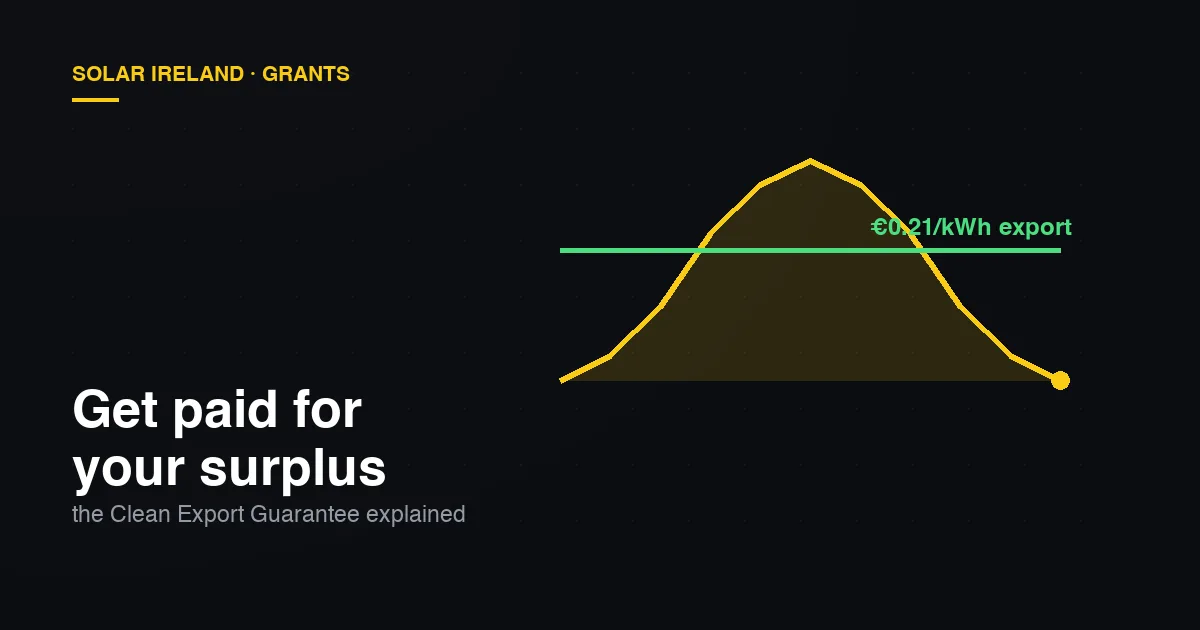
Think of the smart meter as the till for your Clean Export Guarantee (CEG) income. It counts each unit you send to the grid, and your supplier pays you on that count. With no smart meter, nobody measures your export, and nobody pays you for it.
A smart meter is a digital electricity meter that replaces your old analogue or digital meter. It measures your electricity consumption and, crucially for solar customers, your electricity generation and export in real time. Unlike old meters, which could only measure the net flow of electricity, a smart meter tracks import and export separately, giving you and your energy supplier an accurate picture of your energy flows.
No need to wait for the meter
You do not need a smart meter before install day, and you should not delay your panels for one. Check whether you already have one (most Irish homes do), and if not, request one from ESB Networks around the time you book. Your bill savings start on day one; export payments start once the meter is fitted and your supplier registers you for the Clean Export Guarantee.
ESB Networks Smart Meter Programme
ESB Networks has been running the National Smart Metering Programme since 2019, with the goal of upgrading every home and small business in Ireland to a smart meter. The programme was originally targeted for completion by the end of 2024, and as of 2026, the vast majority of Irish homes have already been upgraded. However, there are still properties that have not yet received a smart meter, particularly in rural areas or newer housing developments.
The smart meter installation is completely free. ESB Networks covers all costs, including the meter itself and the installation labour. There is no standing charge increase or hidden fee - the smart meter simply replaces your existing meter and operates alongside your current electricity supply arrangement.
How to Check if You Already Have a Smart Meter
Before requesting a smart meter, it is worth checking whether you already have one. Many homeowners do not realise they have been upgraded, as ESB Networks typically does the replacement without a prior appointment. Here are the ways to check:
- 1Look at your meter - Smart meters have a digital display (sometimes with scrolling text) and typically display your consumption in kWh. They are usually white or grey rectangular boxes, larger than old analogue meters. If your meter has a spinning disc or small dials, it is not a smart meter.
- 2Check your electricity bill - Some suppliers include smart meter data on your bill, showing half-hourly or daily consumption patterns. If your bill includes this level of detail, you likely have a smart meter.
- 3Ask ESB Networks - Contact ESB Networks through esbnetworks.ie with your MPRN (the 11-digit number on your electricity bill) and ask whether your property has a smart meter installed.
How to Request a Smart Meter
If you have confirmed that you do not have a smart meter, requesting one is straightforward. The process is as follows:
- 1Request a smart meter from ESB Networks through esbnetworks.ie.
- 2Provide your MPRN number and contact details. ESB Networks will schedule a survey of your meter location.
- 3An ESB Networks contractor will visit your property to assess the meter location and confirm installation requirements. This usually happens within 2–4 weeks of your request.
- 4The smart meter installation itself takes 1–2 hours. You may experience a brief power interruption (typically less than 30 minutes) during the swap.
- 5After installation, the meter is activated remotely. Your energy supplier is notified automatically.
- 6Within 1–2 billing cycles, your smart meter data will begin appearing on your electricity bill.
The timing depends on ESB Networks' schedule in your area. It does not hold up your installation: your panels generate and cut your bill from day one, and export payments start once the meter is in, ESB Networks has your NC6 notification and your supplier has registered you. Requesting it when you book your installation is plenty early.
Are smart meters compulsory in Ireland?
ESB Networks is replacing every electricity meter in the country under the National Smart Metering Programme, and the CRU notes that old analogue meters are no longer available to install, so a faulty one is replaced with a smart meter (cru.ie). Some households told ESB Networks they did not want one when it called, and ESB Networks records that choice. In one published case the CRU did not uphold a request to remove a fitted meter, because the household had not told ESB Networks beforehand.
For a solar home the practical answer is different: you need one to be paid. Under the CRU's eligibility rules, if your home is eligible for a smart meter you need one to be paid for the electricity you export, and you lose deemed export payments if you refuse it (esbnetworks.ie). If you turned one down before, contact ESB Networks or your supplier and ask for it to be fitted.
Which meter does a solar home need?
One meter: the ESB Networks smart meter on your house. It records the electricity you import and the electricity you export separately, every half hour, and your supplier pays your export from those readings. ESB Networks owns and fits it, free.
| Meter | Who supplies it | What it measures | Do you need it? |
|---|---|---|---|
| Smart meter | ESB Networks, free | Import and export, every half hour | Yes, to be paid for export |
| Old analogue or digital meter | ESB Networks (being replaced) | Import only | No; it cannot record export separately |
| Inverter monitoring | Comes with the inverter | What the panels generate | Already included; nothing extra to buy |
| Separate generation meter | Not required | Generation | No, not for a domestic system |
You do not need to buy a separate solar meter. Your inverter's app shows what the panels generate, and the smart meter shows what crosses the grid. ESB Networks aims to fit a smart meter within four months of processing a valid NC6 notification, and export before then is not paid (esbnetworks.ie).
Half-Hourly Settlement
One of the most important features of a smart meter for solar customers is half-hourly settlement. This means the meter records your electricity import and export every 30 minutes, 24 hours a day, 365 days a year. This granular data serves several critical functions:
- CEG payments - Your energy supplier uses half-hourly data to calculate exactly how much electricity you exported, ensuring you are paid accurately for every unit
- Time-of-use tariffs - Smart meters enable tariffs that charge different rates at different times of day (cheaper at night, more expensive during peak evening hours)
- Demand response - Future energy schemes may reward you for shifting heavy electricity usage to times of high solar generation or low grid demand
- Monitoring - You can track your solar generation, self-consumption, and export patterns through your energy supplier's app or third-party monitoring platforms
Time-of-Use Tariffs: A Hidden Benefit
Smart meters unlock access to time-of-use (ToU) electricity tariffs, which charge different prices depending on the time of day. For solar panel owners, ToU tariffs offer a significant additional saving opportunity:
- Day rate (8am–11pm): Standard electricity price, typically €0.35–€0.45/kWh - this is when your solar panels are generating and offsetting your usage
- Night rate (11pm–8am): Discounted price, typically €0.20–€0.25/kWh - perfect for charging EVs or solar batteries on cheap power
- Peak rate (5pm–7pm): Some tariffs charge a premium during the evening peak - with solar, you can avoid this by using stored battery power
For households with an electric vehicle or a solar battery, a time-of-use tariff can save €300–€500 per year by shifting heavy charging to the cheap night-rate window. Without a smart meter, you cannot access these tariffs.
The Full Process: Smart Meter to CEG Registration
To help you visualise the complete journey from smart meter to earning CEG payments, here is the end-to-end process:
- 1Request smart meter from ESB Networks (if you don't already have one)
- 2Smart meter installed and activated (this can happen before or after your panels go in)
- 3Solar panels installed by SEAI-registered installer (1–2 days)
- 4Installer registers your system with ESB Networks as a microgeneration unit
- 5Contact your energy supplier to inform them of your solar installation
- 6Supplier switches your account to a CEG-inclusive tariff
- 7First CEG payment appears on your electricity bill (2–4 billing cycles after registration)
Don't Worry - It Is Easier Than It Sounds
Most solar installers handle steps 4–6 on your behalf as part of their installation package. Your main job is making sure a smart meter is fitted so your export can be paid; it does not have to be there before installation day. Everything else can typically be managed by your installer.
CC
Written by
Cal Chesters
Founder & Lead Installer, Solar Ireland
Over 10 years in the Irish solar industry. Cal started Solar Ireland to cut through the noise and give homeowners a straight answer on what solar is worth.
More about Solar IrelandSee it on your own numbers
Everything above is general. Thirty seconds with your electricity bill turns it into your system size, your saving and your payback.
Related to: Is a Smart Meter Required for Solar Panels in Ireland?
Related Guides
Newsletter
Stay Updated on Solar Savings
Solar tips, SEAI grant updates, and honest advice for Irish homeowners. Newsletter sign-up is coming soon.
Coming soon
We respect your privacy - we will never share your details.

Chat with us 💬