Prices went up and stayed up
Average home rate per kWh, all-in. Source: CRU, SEAI.
Every unit your panels make is one you don't buy at that price.
Upload your electricity bill and our AI will show you exactly what solar will save you.
SEAI Registered InstallersRECI registeredSince 2019

SEAI only pays the grant when a registered company does the work. We are SEAI and RECI registered, founded in 2019. We book your BER, send SEAI the paperwork, and you track every step of your project on your phone.
Four steps from your bill to SEAI paying your grant, and who does each one.
Upload your bill, or type the amount. We read your unit rate, standing charge and day/night split. You see your yearly saving, the right system size, your grant and your payback in about a minute.
You, onlineYou get your full estimate by email, and we ring you the same day to talk it through. If it's late, we ring first thing tomorrow. We only ask for your name, mobile and email.
Us, on the phoneOn the call we check what a bill can't show: your roof, your meter and when you use power. Then you get a fixed-price proposal. Before work starts you apply on SEAI's grant portal and we notify ESB Networks with the NC6 form.
Us, with youOur RECI-registered team installs, then we book your BER and send SEAI the paperwork. Once the BER is published, SEAI pays your grant of up to €2,400, normally 4 to 6 weeks later. You can track every step in real time.
Our team, then SEAIPanels make your own electricity by day, and your supplier pays you for what you don't use.
Average home rate per kWh, all-in. Source: CRU, SEAI.
Every unit your panels make is one you don't buy at that price.
Under the Clean Export Guarantee your supplier pays you for the power you send to the grid. Each supplier sets its own rate, and the CRU sets no minimum. It arrives as a credit on your bill, through your smart meter.
Panels run on daylight. A south-facing 4 kWp roof still makes about 110 kWh in December.
It starts with a photo of your bill. You see your saving, your grant and your payback first, and we ring you the same day.
Bill Analyser
Your yearly saving, the right system, your grant (up to €2,400) and your payback. Under a minute, nothing to sign up for.
Photo or PDF. The PDF from your supplier's email works best.
Type my bill amountNo bill to hand? Answer three questions instead.This site doesn't store your bill. An AI reading service reads it and sends back the figures. We keep those figures with no name or address on them. Your name, Eircode and MPRN only reach us if you book the call. Our privacy notice
SEAI pays it after the work, for homes built and occupied before 2025. Panels on a home carry 0% VAT. We walk you through the application.
Set by SEAI and may change. Current details on seai.ie.
Do you own your home?
The SEAI grant is for homeowners, including private landlords. A tenant cannot apply, but their landlord can.
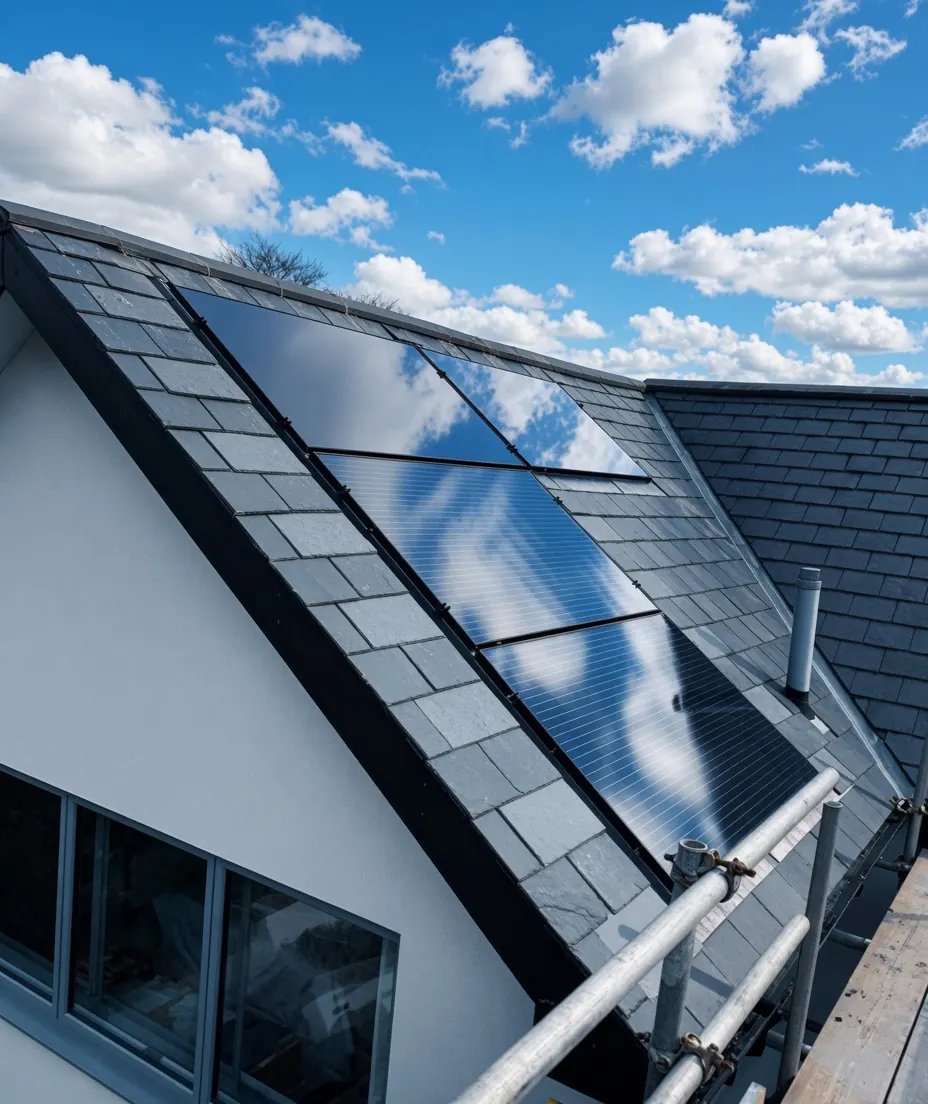
Every photo here is one of our own installs, from family semis to a commercial flat roof.
Cost, the grant and your roof. Anything else, ask us on the call.
A 4 kWp system, our starting size for homes, costs €8,200 installed. After the full €1,800 SEAI panels grant that is €6,400 out of pocket. Larger systems price better per kWp. Your cost depends on system size, your roof and whether you add a battery, and every quote is itemised. Check my savings for your own figure.
A 3-bed semi with a 4 kWp system saves €800 to €1,400 a year on our estimates, depending on how much power you use by day. Over 25 years that comes to €25,000 to €50,000. Your own bill gives a closer figure. Check my savings.
A 4 kWp system costs €8,200 installed, €6,400 after the grant. At about €1,100 a year saved, a typical home's figure, it pays for itself in about 6 years. The panels carry a 25-year warranty, so most of their working life comes after payback. Check my savings for your own payback.
SEAI pays up to €2,400 towards home solar: a Solar PV grant of up to €1,800 for the panels, plus €600 for a battery of 5 kWh or more on the same application. It is for the Republic of Ireland only. You must own the home (private landlords can apply too), it must have been built and occupied before 2025 with its own MPRN, and the property must not have had solar funding before. There is no minimum BER: the BER is done after the work, before the grant is paid, and we book it for you. SEAI pays the grant into the account nominated on the Request for Payment form, normally about 4 to 6 weeks after the post-works BER is published. We confirm your eligibility on the call and walk you through the application. Check if you qualify
For most homes, no. Since October 2022 (S.I. 493 of 2022), rooftop panels on a house are exempted development with no area limit, if they sit within 15cm of a pitched roof (50cm on a flat roof) and at least 50cm from the roof edge. Protected structures, Architectural Conservation Areas and panels on walls are the exceptions. We check this on the survey.
Panels go on tiled, slate and metal roofs. A south-facing roof at 30 to 40 degrees is best, and east and west roofs make less but still work. On the survey we check direction, pitch, shading and structure, then tell you what your roof can carry.
Yes. A battery stores daytime power for the evening. A 5 kWh battery adds about €3,200 to a system, and a battery of 5 kWh or more carries a €600 SEAI grant on top of the solar grant. It pays back slower than panels, so we size it on the survey against your real day and night use. It suits you most if you are out by day or charge an EV.
Your panels send what you don't use to the grid. Under the Clean Export Guarantee your supplier pays you for it, at a rate each supplier sets (the CRU sets no minimum). Our estimates use €0.18/kWh. For a 4 kWp system with no battery that comes to about €410 to €480 a year. It arrives as a credit on your bill, through your smart meter. See the export rate we use